Troubleshooting

Soapmaking Troubleshooting!

Here are some common issues you might encounter when making soap.

Overheating

Every soapmaker will come across overheating issues at one time or another. Maybe you get in a hurry and mix your soap when the oils and lye are too hot. Or perhaps you purchase a new mold and over insulate it. It happens to us all!

Overheating is also common when soaping with any kind of additive that has sugar including sugar itself, honey, beer and milk. Here are some common signs of overheating and what you can do if it happens.

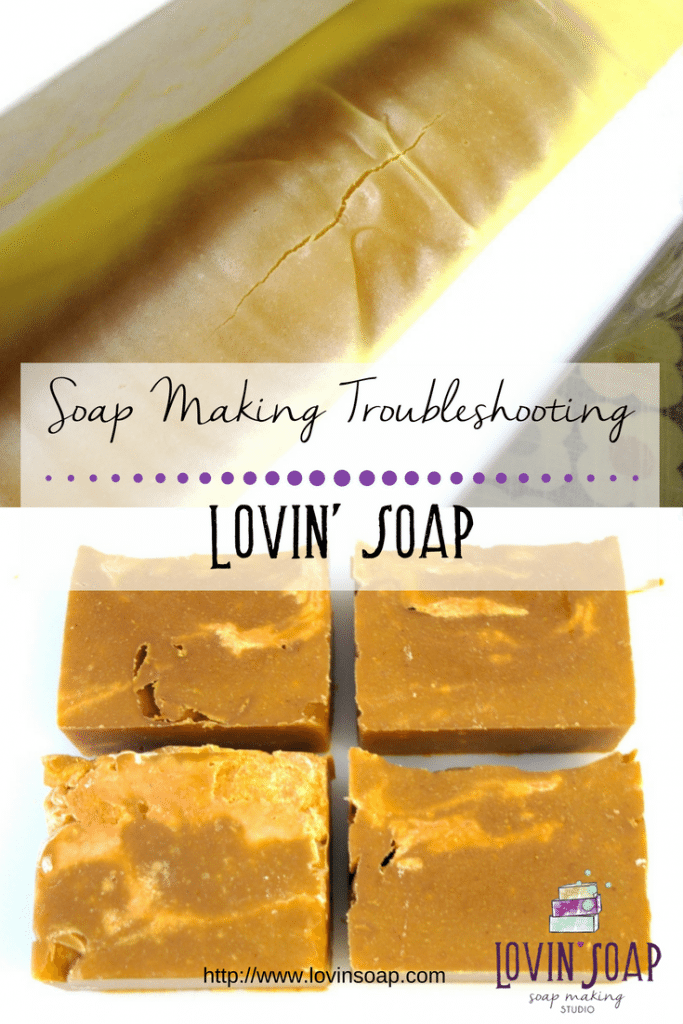
The soap has a crack up the middle of it
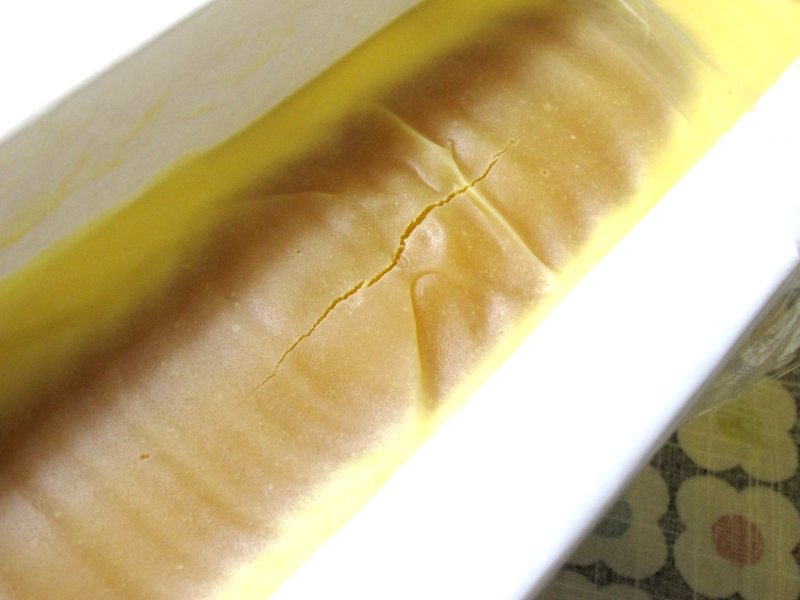
If you find your soap cracking then try to cool it down.  Remove any insulation that you might have on your soap (blankets, etc.), put your soap in the fridge if it will fit or simply leave it un-insulated in a cool place with plenty of air circulation.  It should start to cool down and stop cracking.  You can actually use a spatula or a gloved hand to flatten down the crack.

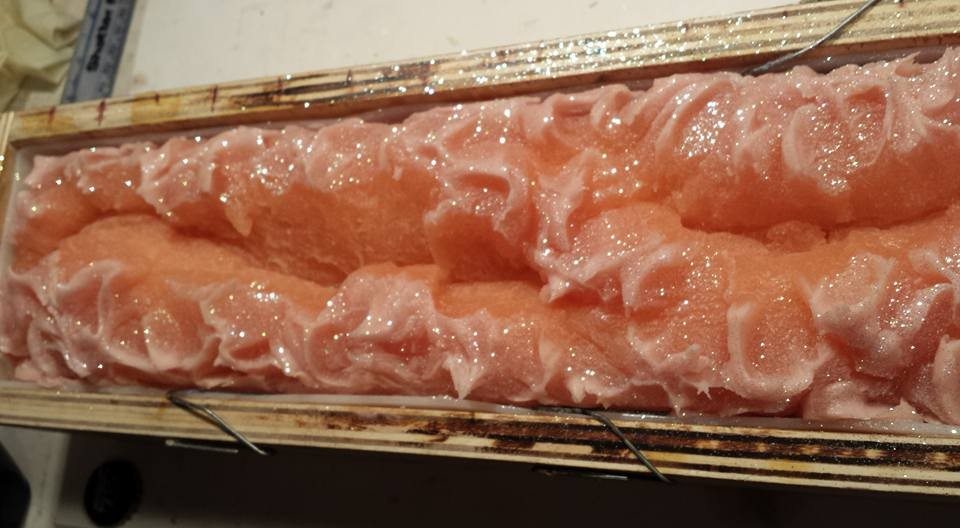
The soap is crawling or mushrooming out of the mold
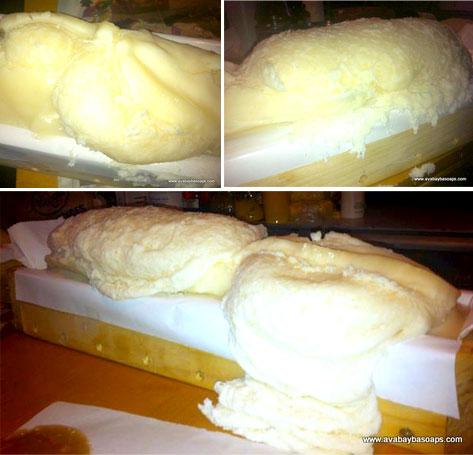
Soap volcano pic by Theresa at AvaBaybaSoaps.com

EEK!  If you catch this happening in process see if you can dump what’s in the mold into a mixing container to let it cool off.  Be careful as the soap will be hot.

Usually you don’t catch it in time and you find it already volcano’d all over the table that your mold is sitting on.  Scoop up what you can and put it back into the mold.  It won’t be the prettiest soap in the world but it will still be soap.

The soap has a layer of oil on top

If it is just a bit, more like a sweat than a pool…then just leave it and the soap will probably reabsorb.  If it is enough oil to pool up and move around if you tilt the mold then you might want to rebatch.  You can do so immediately.  Simply plop it into a crockpot and hot process it.

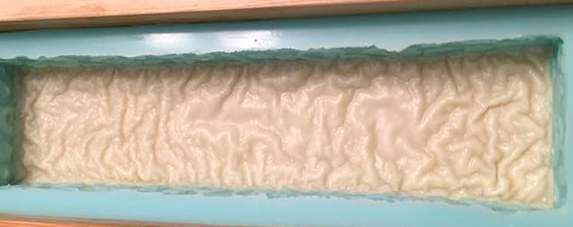
The soap looks like brains

I have not actually had this happen.  I’ve seen pictures online and have heard the tales.  I would actually keep this one.  It might be a good soap for Halloween!  (But next time…soap cooler.)

Mixing and emulsion issues

Soap has separated in the mold

This could be due to false trace or simply not reaching a steady emulsion.  Dump the mixture back into your mixing container and stir some more until emulsified.

When you cut your soap you go through a very soft layer and then a hard one

I would re-batch.  Cut your soap into cubes.  If it is fresh soap, you shouldn’t need to add water.  Put it into the crock pot or pan in the oven.  Once the soap get’s loose and gel-like stir like crazy!

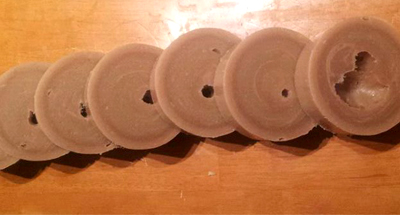
You cut your soap and you have pockets of oils or lye

The soap in the above picture was scented using a spice FO and a bit of Clove EO.  Both are FAST movers.  I also made my lye solution using coconut milk.  I couldn’t completely mix the soap before it started setting up.  You can easily see the lye heavy parts in the soap as well as lye pockets that formed.

If you are sure that you measured everything correctly then you might have had a mixing issue.  I would chunk it up and re-batch as above.

Fragrance oil issues

Fragrance oils can cause a lot of issues with soap making.  Make sure that you purchase fragrance oils from reputable suppliers that test to insure compatibility with cold process soap.

You have fragrance pockets or hard waxy-like fragrance blobs in your soap

You can either reserve the soap for personal use or re-batch.

Some fragrance oil causes seizing.  You bring your soap to trace, add the fragrance and it gets hard and lumpy.  Some soapers like to call this “soap on a stick.”

Your soap is seizing!  The best thing to do here is to dump the mixture into a crock pot and hot process it.

Some fragrance oils accelerate trace.  This means that once you add them to your soap mixture…it moves fast getting thick.  Not quite bad as a seize…still workable.

These fragrance oils (though tricky) are okay to use.  To slow them down a bit make sure you use full water.  I also recommend adding the fragrance oil to your oils before adding the lye.  Then stir with a whisk to trace.  It won’t move as fast as using a stick blender.

You add the fragrance oil to your soap and it immediately heats up and goes through gel phase right in the pot.

Some fragrances cause your soap mixture to heat up.  These include floral fragrance oils and spice fragrance oils.  Soap cooler, use full water and add the fragrance oil to your oils before adding the lye.  Stir with a whisk to bring to trace.  If your soap is going through gel phase right in the pot you can go ahead and let it gel completely in the pot (insulate if needed) and then dump it in a mold.

You go to cut your soap and it has beads of liquid or your soap is oozing a bit of liquid.

Sometimes fragrance oils can ooze or bead out from a soap.  This might have something to do with overheating as well.  I would let the soap sit for a day or two to see if it reabsorbs the liquid.  You can also wipe off if it’s a very small amount.

Other various issues you might encounter

Soap is crumbly upon un-molding

This could be because of two reasons.  Your soap could be crumbly because it did not go through gel phase.  This is especially common in soap that has partially gelled.  The center is solid and hard but the edges are crumbly.  This is just a cosmetic issue…the soap is not bad.  If you want to avoid this issue then make sure that your soap completely goes through gel phase.  You might need to help it along by insulating your mold or putting it into a warm oven.

The other reason for crumbly soap is that it could be lye heavy.  Wait a couple of days and do a zap test.

If you’re new to soapmaking I would just throw this batch away.  Some people will tell you to re-batch adding more oil or to shred and use as laundry soap.  Those are certainly more advanced options you might want to consider after you’ve had some more batches under your belt.

Soap is soft and squishy like play-dough upon un-molding

There are a couple of reasons that this can happen.  First take a look at your recipe.  Are there are high percentage of soft oils such as olive, sweet almond, castor, apricot kernel, etc.?  Did you use the full water amount?  Soaps high in soft oils using full water are going to be pretty soft when un-molding.  Wait two or three extra days before un-molding.  Next time reformulate your recipe to include a higher percentage of hard oils or a steeper water discount.

If you have a well balanced recipe with plenty of hard oils then another reason might be that you mis-measured and did not add enough lye to the batch.  Since you don’t really have a way of knowing how much more to add, I would just save this soap for personal use.  It should harden up a bit with a cure.

Soap will not un-mold from a silicone mold

When soaping in silicone molds without liners you want to make sure you are using a recipe with a high amount of hard or brittle oils (60%+).  It also helps if your soap goes through gel phase as it will be harder upon un-molding.  If you find yourself in this situation, put the soap in the fridge for about two hours to freeze solid.  Then try and remove.

Soap will not trace or is slow to trace

Soap made with high amounts of olive oil take the longest to trace.  Even then…a two pound batch should definitely reach trace in less than ten minutes when using a stick blender.  So if you’ve been stirring for that or longer…then something might wrong.

First check your water amount.  Using high amounts of water with recipes high in olive oil have a hard time tracing.  I always use a water discount with recipe that has 60%+ of olive oil.

Did you add your lye solution?  Don’t laugh!  This has happened before to many soapmakers.

Temperature plays a big role in trace.  Higher temperatures will make soap trace faster while lower ones will slow trace down.  So if you have a recipe that takes forever to trace…then use higher temps.  If you have a recipe that moves like a freight train…then use lower temps.

If your soap will not trace…then you might have lye issues.  Are you using a new container of lye?  Was it clumpy or hard when you used it?  This could suggest that it has absorbed moisture somehow so your measurements will be way off.  Instead of weighing out the correct amount of lye you’ve weighed out lye and the moisture that it’s absorbed.  If your lye is clumpy or hard then get new lye.

111 thoughts on “Troubleshooting

  1. I tried the column swirl technique, and realized afterwords that my wood column was pressure treated. I have not cut the soap yet, but so far it looks great and appears to have gone through gel phase.. However, I noticed tiny amber, glittery-like beads on the surface and wiped them off. Was this chemical from the pressure treated wood or excess essential oil? Will my soap be safe to use?

    • Steph,
      The chemicals in pressure treated lumber are arsenic salts, chromium salts, and copper salts. The copper isn’t a big deal for humans, and chromium depends on exposure. Arsenic is absorbed readily into your cells and interrupts normal energy production, hormone processes, and can lead to both programmed cell death and cancer. Long term, low exposure leads to low energy levels, and a massive increase in cancer risks (still small, but very measurable).

      If you didn’t use a liner, then you definitely absorbed the chemicals into your soap. It’s safest to throw out the soap, but if you wanted to keep it, you’d have to keep it only for yourself. It would be illegal to sell it.

      If you did use a liner, but the lumber was fresh and cool/damp to the touch, then it’s possible the outer layer of your soap may have traces of the chemicals. Mostly, it would be smell, since the primary chemicals for PT lumber are salts that don’t evaporate.

      If you had good liners, and the pressure treated wood was dry (at least a couple of months old, not brand new from the hardware store), then it’s all good. Just remember to wash your hands after handling the mold, and don’t use soap scraped off of the edges of the mold.

    • As to the amber beads on the surface, 99% chance that those were bits of oil weeping out of pores in the soap. Amanda’s reference up top about this holds true so long as the mold has liners, or has been sealed (polyurethane thinned with acetone, 3 coats) to prevent the PT chemicals from entering the soap.

  2. I was given a bunch of lye from a woman who used to make soap. One of the containers was full of lye but it was hard. I broke it up and used it in 2 batches on Saturday. It’s now Monday and my soap is really, really soft and has pooled some oil on top. Is there anything I can do to save it or is my lye completely off, due to moisture and I should just throw it away?

    • (Sorry Amanda, I love answering technical questions, and your blog is too awesome to not listen in to!)

      Jackie, unless you want to spend 4 hours playing at the stove, then it’s probably better to ditch the lye and the batch, and start over with dry lye.

      The problem is that it’s really hard to tell exactly how much water the lye has taken on. There’s not a formal measure of how much water tha lye will pull from air, and at what humidities.

      Technically, you salvage the lye by baking it to dry it out. That’s dealing with lots of lye, in the open. Hazards galore, but it’s doable. Some people do this with liquid lye to get standardized amounts (back to crystals). Just note that if you dispose of the lye, you cannot just throw it in the trash. It’s still hazardous. Either massively dilute, neutralize, or contact your city waste disposal for help. OR, you could save it for cleaning drains. :)

      If you’re really adventurous, you could titrate the soap to a proper pH. This would require heating up the soap in the cauldron, which I find takes about 30 minutes in a double boiler for a 5-6 pound batch. Once it’s liquidy and well mixed, dip out just a tiny bit of the soap, and mix it with water. Use the plastic pH strips (not paper). I got a pack of 100 from Amazon for $16. The brand that works and is available Prime is “ColorpHast”.

      Oils, if they showed up on their own, would have a pH around 6. Lye is 14. Your target is usually 10, or a little under. If you got to a pH of 8, then you might add 50% more of the humid lye, in 1.5x as much water. Mix well, let it cook for about 30 minutes, and re-test.

      If it turns to soap, then you’re probably pretty close. If it stays liquidy, you still have a way to go. If it turns crumbly, then you went too far (pH 11.5 or higher). Expect sore shoulder muscles. Once you reach 9.5 or a little higher, call it quits and pack it into molds. It’s easier to add a little lye water, but once it hardens, adding more oil is harder work. It probably will react a little more, but it’s better to be a little superfatted than superlyed.

      Keep track of the total amount you had to add. If your recipe said use 200 grams, and you had to add another 100 grams, then you’ll know your conversion factor for THIS chunk of lye is 150%. Also, once it’s cooled in the molds, re-test the pH. You can use that to adjust a little more. If you leveled out at pH 9.75, you’ll know that you’re still 10-15% superfatted. You wouldn’t want to superfat on top of that, or use oils that go rancid too easily.

      Also, this would be rebatched, hot process soap. Expect it to be lumpy and annoying in the pot, and to be pretty hard to stir once it is done saponifying. If it gets a little warm during the reaction, it will try to foam out of the pot. The mold may take a while to cool, and hardness will depend on residual water. If you’re at 15%, it will be pretty hard once it’s cool. If you’re at 25%, it will be fairly soft, but you could unmold it once it’s cool so it will dry faster.

      Also, this all assumes you’re working with actual lye, as in Sodium Hydroxide (NaOH) granules. If you’re dealing with potash, or Potassium Hydroxide (KOH) flakes, then your soap will never fully harden. If you did KOH, then you’d have to add in almost an equal amount of salt to convert it to sodium soap and be hard enough to cut into bars.

  3. Hi! I am new cold process soapmaker. I am trying to learn how to make swirls in my soaps, but for some reason I can’t. I have some questions about this situation. It is a fact that if the mixture go through gel phase, I can’t make swirls. What do you suggest me? Light trace? How much time do I have to wait for unmold if my soap was in light trace? Also, I use oxide pigments but sometimes leave flecks of unincorporated color, but I don’t want to stir so much because I don’t want a heavy trace. What is a good way to mix the colors without obtaining a heavy trace? What colors are better for cold process? Are silicone molds good for cold process?

    Thank you so much, and sorry for asking so many questions, I’m a beginner ^.^

    • Heavy trace gets really close to being clumpy. Swirls are more of a light to medium trace. Keeping your temps down can help give you enough time to work with your emulsion. A little more water, or a higher olive oil percentage (not pomace) will also give you more time. Starting with your additions at just the hint of trace can help too, as long as you’re far enough along to not separate.

      One thing some people do is, while well mixed, but not quite tracing, you can dip out some and add pigment to that separately. Then re-add that at the appropriate time.

      Alternatively, you can mix your pigment with essential oils, glycerine, or superfat oils, and swirl those in. This is pretty common, along the lines of a teaspoon of pigment for ounce or two of liquid. If it’s not hot, you could mix this in a plastic bag and use your fingers to squish any unmixed pockets. You could then cut off the tip of the bag and drizzle it onto your soap if you wanted to play with lines.

      If your swirls are too thick, and your emulsion separates, and your color base is NOT raw soap emulsion, then the color areas might not fully turn to soap. If you reach gel phase, they should bleed a little and be just fine regardless.

      Gel phase just means the soap heats up enough to soften internally, and it reacts more quickly. It may bleed little bit, but there are plenty of CPOP soapers out there with really crisp, fine, beautiful swirls, and the OP guarantees a gel phase. The key is to make sure your soap doesn’t separate (pour at false trace), or volcano (over heat in the mold), which would really be no fun.

  4. Hi. I cannot understand why my soap is cracking badly on top. It is very cold here at the moment in UK ( about 4degree) I am making soap into 3kg wooden log moulds. I do not put my heating on in the house whilst soapmaking to keep the temperature down but I am still getting very big cracks across the top of the soap. I use coconut oil, Palm oil and olive oil in my soaps and the last 3 batches have cracked and look terrible. I peak the soaps on the top so cannot cut the top off. I cover the moulds with cling film lightly but do not cover in towels etc. Please help!! : (

    • What temps are you soaping at? Wood holds heat. Are you making milk soap? You can also try putting your mold in the fridge after you pour.

    • Cracking is shrinkage without elasticity. If the surface cools and dries more rapidly than the core, then the surface hardens. As the core shrinks, the center dips, and splits.

      If you ensure it’s cooler before moulding, that can help tremendously. It’s the change in temperature, not the absolute temperature, that really does the damage.

      As Amanda says, hot core temps can be from milk (additional additives). Also, if you pour early, with a high concentration lye, you might get an early trace, but still have tons of reaction left.

      This can also happen if incomplete soap is poured at high enough temperature that it foams slightly (~90C). The top will skin over, and then when it finishes, it will cool, shrink, and split the top.

      If the soap stays warm, it can be soft enough to stretch rather than crack. This could be an issue if you’re avoiding gel. It also can lead to surface drying, which can still crack.

      If the soap starts life with too much water, then it can crack during cure, even if temperature is well regulated. (Think of clay mud in arid places – always lined with huge cracks.)

      If you have good mould release, then the top of the soap can pull away from the sides rather than cracking, but you might have a tapered loaf from this.

      You could use full contact plastic or parchment to help this some, but you couldn’t have a peaked surface. Also, after unmoulding, it could still crack while drying. Cutting it into bars as soon as possible could help with that.

      Alternatively, you could use a vertical mould. I do this with HP soaps, and actually mound the soap above the top of the mould at 80C. By the time it’s down to 40C, it has shrunken to be flush with the top. A 3-4″ exposed surface isn’t enough for the soap to crack during cooling.

  5. thank you doing this how to i have been looking for ages to find out how to do cp topping so will be giving this a go asap , i tried to make beer soap last year it had a great honey colour to it & the outside had a velvety feel ( bit like the skin on some cheeses) but i kept testing the ph with a solution thats stays clear if it good or pink not good !! even months later it was still pink anyway i gave it ago & it was slimmy so i dumped the lot , thank you once again

  6. Help! My soap traces like normal, but when molded and placed in insulated cooler to “sleep,” it expands and grows and oozes out, just like the picture posted earlie in this post. Does that happen because its too hot? Help!

  7. I guess I need help in a Big way. Not all the time but sometimes I get brown spots. Whats is the cause. Its can happen on Unscented Goat Milk to My Carrot Soaps, its doesn’t matter. I can make a batch and everything is great and then here come the brown spot again.

    • Brown spots is usually a sign of burnt something (milk or sugar), fragrance oil, unmixed honey or colorants.

      So you mention goat’s milk and also carrot soap. Goat’s milk – are you making your lye solution from goat’s milk and lye? Or are you adding goat’s milk to the oils. If you are adding it to the lye you could be getting burnt globs of milk that end up in the soap. Same with carrots if you are using puree carrots in the lye mix.

    • Any additive could be leeching colors into the soap, so experimenting with micro batches might be helpful to isolate the problem.

      Carrots turn dark when they oxidize. If the pulp wasn’t strained with filter paper, then little fragments could be turning dark, and leaking into little smudges in the soap.

      Some EOs turn dark, and if they’re not fully mixed, or are soaked into organics, then they can leech into the soap later.

      If the milk isn’t caramelized when you add it to the oil, then maybe it’s heating up in the pot (streaks inside and out) or after pouring (splotches inside and out). Digital thermometers are really helpful, but will only give you temperature averages – not hot-spots temperatures.

      If there’s high superfat (over 5% or so), then it could be rancidity (oxidized substances in the oil). Using oils with more Vitamin E like cottonseed can help, as could food-grade additives like sodium benzoate.

      Lastly, if the soap has lots of wet organics, then it could be bacterial. This would be mostly on any exposed surfaces, and not inside until after it’s cut and rested. This would be the case if you scooped out all of the little spots into a plastic bag, and the spots all smelled very different from the rest of the soap.

  8. Hi Amanda

    the cold processed soap traced very fast and was problematic to mold. Apparently turned out be be hollow and bad shaped :(
    Can that be hot processed at this stage in the crockpot?

    thanks

    • Almost any soap can be re-batched. Melt it down in a double boiler. Once it’s been fully melted (slimy, not purely liquid) for about 30 minutes, spoon out a tiny bit and test it with plastic pH strips. If the pH is good, then you can just re-mold it. If the pH is off, then you’ll need to adjust your formula.

  9. Hi
    My last 3 batches have been crumbly when I cut my loaves. They are firm on the outside and come out well when in individual small molds. I have been using cocoa butter. Does that impact the soap. In the summer I used almost the same recipe (the same quantity of lye) and it was much easier to cut. Does cold temperature make soap more crumbly or should I try less lye and no cocoa butter?

    Thanks Teri

    • The amount of cocoa butter shouldn’t really matter. You can make a 100% cocoa butter bar and it will be fine.

      The number one cause of crumbly soap is too much caustic. If it were mis-measured, or the wrong value pulled from a list, or if the cocoa butter were cut with some other, lower-SAP oils.

      If this only happened in the core, and the outside is normal, then this could be some form of separation.

      Have you tested pH of both parts? The plastic test strips are something like $16 for 100 from Amazon Prime. I would expect the inside to be over pH 11.5, and the outside to be under pH 10.

  10. I was wondering if there is any drawback to making soap in the cold. I work in my new studio in the basement, and its cold. I dont mind, it cools the lye and oils fast but it does take an extra day or two for the soap to be able to be unmolded and cut. I havent had any issues so far, just wondering if I am slowing the process of curing or anything. Thanks!! :)

    • Mostly that’s it… Basic chemistry
      * If it’s hot, and mixed, then it reacts more quickly.
      * If it’s cold, solidified, and not mixed, then it occurs more slowly.

      Considering there are poured chunks of concrete 100 years old that still have unreacted concreat in the middle, the same thing CAN happen to soap.

      I’m sure there’s a way to calculate this, but I’ve not seen an easy way.

      If your soap gels completely, then it’s done reacting for certain. Cure time would just be as long as you like for it to dry out sufficiently.

      If your soap pours cold, stays cold, and never gels, then you might have to test the pH to see for certain if it’s 100% reacted.

    • Soaps containing medications or drugs of any sort would be regulated by the FDA. Packaging requirements are much higher, in that they must list lot numbers, drug facts, and detailed ingredients, among other things.

      Beyond that, “medicated” is pretty vague, and would be a big topic. That topic would not belong under “Troubleshooting”, but I’m not sure that Amanda would really want to get into the liabilities of that.

      Just consider that:
      * Not all substances absorb through the skin.
      * Not all substances would survive being exposed to NaOH or heat.
      * You will need to pick a plan, and research it heavily.

  11. When making goats milk soap I use a soap calculator that accounts for goats milk/lye mixture vs. a water/lye mixture.
    My concern is that I like to strain the goats milk/lye solution to remove the sugars that contribute to the discoloration of goats milk soap if left in the mix.. Does doing this cause the initial calculations to be incorrect for the batch? If so, what should I be doing to fix the problem? Thank you.

    • The caramel solids from saponification heat will already be partially reacted. It shouldn’t greatly affect your calculations. Just know that anything which reacts with the lye prior to adding the oils will cause you to be at a lye discount. As long as you are happy with the soap if you leave the sugars in, then it should be about the same with the solids removed. The exception would be lather, which is sometimes affected (improved?) by having sugar in the soap.

  12. if the lye was a bit messed up and its not tracing can’t I just put in a bit more untill it starts to work? is it not possible to mix and add as you go along? do it by eye so to speak, and what happens if you use too much lye? is it not safer to use less?

    • You could, but using trace as your deciding factor is probably not good. You could titrate using a pH indicator, which is what the big labs do. It takes longer though. You have to add, mix, wait. Doing this, you’d only want to do it hot process, and always add your lye as a liquid — never crystals directly in the soap.

      If you have too little lye, but the soap sets up, then your shelf life could be limited. Unreacted oils, especially polyunsaturated fatty acids, will go rancid from oxygen and bacteria. This will be mostly on the surface of the soap. Vitamin E can help, as can some food-grade preservatives.

      If you have too much lye, then the soap will deposit that lye on your skin. It will turn your skin oils into soap, including some of your skin cells. This can lead to dry skin, red rashes, or in extreme cases, chemical burns.

      This is why many people will give up on a “bad batch” of soap; however, if you use plastic pH strips, and fully react and mix your soap after every addition, you CAN safely salvage it. Just be prepared to spend a lot of time doing so.

  13. HI,
    I have only made 2 batches of Cold process soap I used a beginners kit and followed the step by step instructions.
    My soap mix great it was just as it was supposed to be but after I added the Color FO it lumped up a bit I had marble size lumps in my soap I mixed it as best I could and got all but 2 or 3 lumps out I went ahead and molded the soap let it sit undisturbed and wrapped in a towel for close to 48 hours.
    When I cut it into slices everything looked fine I only ended up with 2 bars that had a light spot where one of the lumps apparently was it is maybe a 1/4″ dia. spot.
    My question is since the soap came out bright pink and looked fine other than the one light spot is it ok to use I was told by another NEW soaper that was a lye spot and what is called “lye heavy” soap but I have researched a bunch and it looks nothing like the lye heavy pics alot of soapers have posted.

    Another thing I was wondering someone said to use PH strips to check the PH levels but failed to explain how exactly to do that I ordered some strips but they do me no good if Im not sure how to use them?

  14. Lye heavy areas will be crusty and crumbly rather than waxy.

    The pH strips should have instructions on the case, but here’s the general instructions.

    Scrape some of the suspect area, small particles, into a small dish. You only need as much as you can dissolve in water within about 30 seconds. The water should be filtered at least. If you have really hard water, then distilled water is better.

    The slurry should be cloudy but not opaque. Take the color side of the pH strip and swish it through the soapy water for about 10 seconds. It should soak the little papery bits that are glued onto the plastic test strip.

    Hold the pH strip up to the calibration chart that came with them. Find which color selections look closest to what your strip shows. It’s not exact, but you should be able to measure within 0.5 or better, depending on your eyesight and color perception.

    NOTE1: If you have any color vision deficiencies, then you should get someone to double-check your read of the strips.

    NOTE2: Never re-use test strips. They are one-use. Their color will also change as they dry out, so they’re not long-term reference. You can take a picture of one, but make sure to include the color calibration chart in the same picture, since camera pictures can vary.

    NOTE3: If you got paper test strips, those sometimes don’t read soapy water very well. Test a couple of different soaps, home and store made.

    Comparisons should be:
    * Dove 7.0
    * Lever 2000 9.0
    * Camay 9.5
    * Dial 9.5
    * Irish Spring 9.5
    * Ivory 9.5
    * Palmolive 10.0
    * Zest 10.0
    * TOO CAUSTIC 10.5

    If all of what you test reads almost exactly the same, then your test strips are the wrong ones. ColorpHast brand are good, as are Macherey-Nagel. Both can get you within 0.25 of what a calibrated, digital meter. Vivid and Spectral read substantially lower than lab-grade equipment, and should be avoided for soap testing. (ColorpHast cost me just over $16 for a box of 100 including shipping from Amazon.)

  15. Please help me!! I was making an special order that a customer asked me to. It is a cannabis flower soap. I don’t know why my soap is black in the middle (horrible!!), it’s supposed to be light green! Also it is very hot. I always follow my recipe, but this time I did something different, I used 3 fragrance oils. Patchouli, cannabis & red roses and also I added red roses petals. What I did wrong? Maybe mixing the fragrance oils? I am so disappointed!

    • Rose petals turn black in cp soap. My advice is to never do something a customer orders unless you’ve done it before because too many factors can change the order. To make a soap where the rose petals appear vividly in correct color you would need to be using M&P soaps, and you would want to dip each rose petal with tweezers several times in clear MP to protect it. While letting it cool between dippings on a sheet of freezer paper. Which you should be able to eventually make on your own, however, you need to master CP and HP soaps first. For now I would suggest investing the extra money and buying yourself several pounds of solid white and clear MP, to make the customer’s order correctly, as well as future custom orders. As I assume this is on Etsy, and you should never keep a customer dissatisified on that site.

      I suggest you educate yourself before taking any further custom orders. Learn to research all ingredients before trying something new.

      • Thank you Diana for your advice. But no, this soap is for a friend of mine, and I don’t explore new orders with new customers. Today I revised the soap and it is completely green, there is no black anymore and roses are not black. I just insulated better the mold and that worked for me. I just asked for help, because I never see that reaction before on my soaps and I thought it was for mixing 3 fragrance oils. I did MP soaps for about 2 years and then I switch to CP, so I have a little of experience but I just got scared with that black color in the middle of my soap, but after frustration got a good result.

  16. Hi, I have a huge problem with my soap. I made goats milk honey oatmeal soap using coconut and olive oil. I ground my raw oatmeal to semi-fine (about a like wet coffee grounds) before adding it. At first the soap cooled off too much and would not make trace, so I had to reheat and then it did fine. Poured it into the molds and it was dry and crumbly, so I rebatched it in the oven with more oil as a troubleshooting website said to do. This time, it turned out perfect, easy to cut, beautiful. So I set it to age in my living room.Here is the problem: as it is aging, the surface that is open to the air has grown white crystals, almost like mold. It is not mold, though. It is not oatmeal drying out, it is crystally. What can it be? And how can I save it?

    • The crystals on the surface are called Soda Ash, but it’s not really soda ash. It’s most likely minerals from your water that migrate out of the soap. This is less likely to happen with hot process, or with demineralized water.

      It should be harmless though. If the cosmetics of it are bothersome, then once your soap is cured, you can wash or scrape it off of the bars.

  17. I have a funny problem – if it is a problem. I always make 100% olive oil CP using tea (eg. chamomile) and it’s great, but a little soft. This time I used olive leaf “tea” (boiled for 1 hour and cooled) and added beeswax 9% and propolis 1% to the olive oil. When I added the oils to the lye/tea mix, the mixture went red and thick like tomato ketchup! So weird, I’m used to a pale yellow mixture that I hand beat for an hour to light trace. I used a whisk just to mix it and it quickly got to medium trace. So far so good. Should have added EO and poured into moulds.

    Instead, I put it in a closed pot over hot water (75 deg C) for an hour. Taste test was tingly so I left it another hour when it tested fine. I let it cool to 40 deg C and added tea tree and lavender EO and whisked it a bit but it was really thick and brown like fudge. I had to really push it into the mould and there were spaces at the bottom. When I cut it, some pieces came apart. I have used it to wash my face and it is gorgeous – no burn or anything.

    I presume it is overcooked and/or I used too little water (33% instead of 35% – 10 ml difference.) So can it be rebatched or is there another way to get it to get it to not fall apart?

    • That small of a water difference won’t matter. The beeswax would have increased the melting point of the oil mixture maybe 10C, but being mostly olive oil, that wouldn’t matter either.The olive leaf extract would have accelerated trace substantially, which you already noticed. The propolis probably did the same, but to a lesser extent.

      Then you cooked the soap to completion, aka Hot Process. I find that I can mold HP soap fairly well around 80-85C, though it still takes a spatula and some pressure. You have to move fast, because it starts cooling off pretty quickly as you scoop it. Larger scoops, large molds, preheating the mold, and packing it in with a lot of pressure all help.

      Heating it back up is probably the easiest way to get it into the mold. A double-boiler works faster, because you get steam up the sides of the pot.

      Heating it in the mold is possible, but it’s too easy to overheat, which makes steam, which makes it foam over. You still have to mash it back down.

      Rebatching with water works too, but then your dry-time will go way up without saving you much effort in the re-melt.

      • OK, thanks. I’ll try heating it in the mould with just a mist of water – it seems really dry, like ancient soap. At what temp will I lose the EO?

        I really need this soap to be dry pronto which is why I messed with HP in the first place. Is it possible to speed the drying with a fan or dehydrator?

        • I found that a fan only helps for the outside layer of the soap. After that, it’s just a slow process for the moisture to migrate out. A dehumidifier would be about the same. Going to altitude might help, with the lower pressure, but that seems like a hassle.

          Hot process only cooks out about 1-2% water per hour. For quicker drying, I use less water in the initial batch. I found about 1.5:1 water to lye works pretty well if I’m quick. 1.1:1 works fine, but it requires a third arm because it will react so quickly.

          Misting with water won’t really have any benefit. It will just make a mess.

          Heating it in the mold will probably not work as you think it will. You’ll stick to the mold more, and have a risk of foaming over.

          Re-melting the soap in a double boiler will work whether you’re water heavy or not. I cooked some water deficit soap for several hours and at 90C, it looks the same as full water soap. It should be fairly thick, and stick to almost everything. it will have shiny insides as you stir it.

          If it seems dry and crumbly, rather than just chunky, then you might have lye heavy soap. zap tests and self wash tests are very subjective and not accurate. I recommend pH testing to make sure.

          Your EOs evaporate all the time, and heat definitely accelerates that. I found that rebatching HP soap seemed to drop the scent to about what it would be after a few months of drying. A second re-batch didn’t really change the scent much. I had one soap I really messed up and re-batched it 3 times. I can still smell the orange a little when I sniff the bars, and when I wash, I can smell it stronger than any of my other soaps. It’s been on the shelf for about 5 months.

  18. I am a very new CP soapmaker. I love the chemistry of soapmaking! Anyway, I made a lovely soap with pomace, shea, avacado, and 15% deer tallow. I fragranced with bergamot EO. All is well and it is a nice hard creamy white bar. I used it a couple times on my hands and love the conditioning of it, but then I used it in the shower this morning. I made a lather and sniffed and there was a smell of…well, maybe stinky breath? my daughter said it smelled like poo and thought it was her body chemistry and bergamot. It is a fleeting smell and doesn’t fragrance the body. I still have a lot of the tallow and it is not bad. I also rendered one last time just before soaping to make sure I didn’t have any nasties. Any thoughts about what the icky smell is?

    • It’s really hard to tell without smelling it. I have some random tallow soap that has a waxy smell, a little earthy, but it’s just low on EOs.

      Bergamot has its own interesting smell. Bergamot oil also contails bergamottin, which is a liver enzyme antagonist, and can be absorbed through scent and through the skin. If you used a large quantity of the EO, it’s plausible that it may be interacting with foods or vitamins in an unspecified way that affects your sense of smell. That’s a reach though, not a known issue.

      Well rendered, washed, filtered tallow shouldn’t be much of a problem; however if the deer ate stinky plants, those oils would be part of what’s in the tallow. Some fat is stored directly rather than being reprocessed.

      Really though, it’s hard to tell. Maybe make a mini-batch of unscented, and a mini-batch of some other scent, with the same oils as this batch, and see if they end up with the same smells?

      • Thanks. Yes, there is very little Bergamot EO in the batch – 1%. I love the soap and will continue to use it just because it is such a nice conditioner, but next time I will likely use more EO or a different one.

        • Oh, wow. Yes, I typically use close to an ounce per pound (5-6%) of finished soap for most of my EOs, though I haven’t tried Bergamot yet.

          I tried to make a cinnamon/nutmeg extract and added that at about 2% to one batch. It’s beautiful, but I definitely smell the raw soap as much as I smell the cinnamon. Same thing though. The soap is so good, I don’t want re-batch it, and my friends were happy with it too.

  19. I’ve been making CP soap for about 3 years. A few weeks back I made a batch of Almond Apricot Kernel with coconut 76. The ph is 7 – 8, soap looks lovely, but had a few bright pink spots on it. I tried to find out the cause, but no luck to date. Today I cut a batch of soap made coconut, palm and mixed soft oils, however none of these oils or the EO’s were the same as I used in the previous batch
    There is another pink dot on the bottom of this loaf…..just one
    Any thoughts as to why this is happening?
    Thanks so much….m

    • Sounds like “Dreaded Orange Spots”. pH of 7-8, without adding citric acid, means your soap is at a huge lye discount, or your strips are inaccurate.

      If you are at a huge lye discount (tens of percentage points), then the unreacted soap is going rancid in little spots, nucleating around tiny specks of impurities.

      If this is actually DOS, then using the soap is safe, but it could be unsightly. Also, it will spread, and can lead to unpleasant odors.

      In such a case, use a small scoop (like a 1/4 tsp, round spoon) and scoop out the orange or pink spots. They will be only near the surface. Then, you can re-batch the soap with a little bit of vitamin E (tocopherol) or oils rich in vitamin E (cotton-seed, grapeseed).

      If your soap is more than 5% lye discount (aka superfatted), then you may want to consider reacting more of the oils to come back to a 3-8% superfat/lyediscount. Those soaps will be more stable, and more resistant to DOS.

      Lastly, for pH strips, there have been some pretty good reports, on this for soaping, but basically, only two brands of test strips were able to show proper pH for soap slurry. Both are on plastic backing. One is Machery Nagel pH-Fix, and one is EMD ColorpHast. Also, pH strips have a shelf life. Bad strips, paper strips, or just generally problematic strips will report 1-2 pH low.

  20. Hi again, Thanks for getting back to me so quickly. I rechecked the recipe which was an experimental batch (recipe from one of my soap books)….fractionated coconut 21% Apricot Kernel 9% and Sweet Almond 69% I use Soap Calc religiously and am quite ‘anal’ when it comes to weighing, measuring, checking and rechecking! I knew the iodine was higher …78… however superfat was 7% . This recipe was quite different than anything I’d tried, having such a high % saturated fats. (still learning!!)
    I checked my litmus paper with 5% vinegar and its pretty close 2 + – however I ‘ll look for the pH strips you suggest.
    So…finally an explanation of what my pink spots are!! DPS (dreaded pink spots…much prettier than DOS!!) I don’t know why the other bar has it. It’s super fat is 5% and Iodine 68 . Anyhow, its finally good to have an explanation!! Thanks again …m

    • Hah! I like DPS too! :) The iodine indication shouldn’t really matter. Based on 7%-ish, your pH should have read more in the 9.75 range unless your NaOH had absorbed moisture.

      If your NaOH ever got slightly wet, or was left open, then it’s heavier per unit of NaOH. It won’t really dry out. I measure mine, then close it up and double bag it.

      7% superfat isn’t really excessive, but almond oils are highly unsaturated. They are very susceptible to oxidization (rancidity, crosslinking, conversion to short chain acids and solvents, etc). Vitamin E helps reduce this activity.

      The problem with most test strips is that they work fine for purely aqueous solutions, but soap solutions have such an non-polar component that they often read low. Digital meters called to me, but they require calibration with buffered solutions. What a pain!

  21. Great info Josh!! Wish you were my neighbour!!
    Guess I don’t need to be shy about asking other dumb questions during ‘Marilyns Awesome Soap Adventure’ !!
    lol… thx again…m

  22. I am new to soapmaking. I was making a batch of soap that wasn’t making it to trace when I put two and two together and realized I put twice the water I needed for my 2 lb small batch of soap. There are directions for making several sized batches side to side in my book. I decided to abandon trying to get it to fully trace (I think I burnt out my stick blender anyway) and poured it into a mold and made another batch. Is there anything I can do to save this soap?

    • Extra water won’t prevent saponification, it just slows things down (weaker basic solution). Double water may take 4 times as long. Also, if you used KOH vs NaOH, it takes 3-5 times longer on top of that. Lastly, if your NaOH or KOH was wet, then your measure by mass/weight would be wrong (less than you needed).

      If everything was correct other than water, then you could cook it on the stove. A double boiler is faster than direct heat, but either is fine. Low heat is best, which is 2 or less for most stoves. If you have a thermometer, then aim for 185F or 85C. Stir occasionally, but you don’t have to slave over it the whole time.

      Also, I found that per hour of cooking, I lost 5-7% of the input water. This relates to when it’s done reacting. Expect maybe 4 hours of cooking to get where you want, though if you’re going HP, you might just cook it all the way to the water content you’d like for your final soap.

      When it goes past heavy trace, the soap self-insulates more. Whe your thermometer reads 175F, it may actually be close to boiling temp. If the soap begins to foam/expand/volcano, that means the water is actually boiling inside. Turn the heat down a little, and use a wooden or metal spoon to stir it down.

      Plastic stick blenders can melt in the volcano. Stick blenders shouldn’t be used more than 60 seconds on, 3 minutes off, though half that is probably better. They’re only really useful until medium trace. Anything past that, and you’ll just blend air pockets.

  23. I am making goat milk soap and find that it has started to show a white marbled pattern on the surface of the soap by the second day of curing. I have tried keeping the milk and lye to 35 degrees and mixing oils at about the same temp. I have also looked at insulation as it doesn’t seem to happen when I use a log mold. Nothing I have tried so far has got me back to where I was before summer began with nice clean finished bars. Also when making liquid goat soap can you use the goat milk at the dilution phase after the paste has formed rather than at the beginning when mixing the potassium hydroxide with liquid phase? I thought this would avoid burning of the sugars.

  24. You know it’s burning if it turns brown. Ice-Bath can help when adding lye crystals to the milk. Also, adding it more slowly can help, though exposed lye crystals will absorb water from the air, increasing the amount of liquid in your final product.

    White swirls in the top of the soap are separation of components. You may be pouring at early or false trace, or maybe it’s warming enough to separate during reaction. Sugars will definitely react and release internal heat. If you used a stick blender, then where it churned will locally heat up 20-30F. If stirring by hand, most of the time should be spent scraping the sides. I use a silicone spatula for this, and get good results.

    Ultimately, it’s difficult to know the exact, local temperature in soap, because you’ll have small areas react, heat up, and react more, but it’s very insulating, and won’t be that warm 2 inches over where it finished reacting 20 minutes ago.

    As for which phase, yes, you can really use it at any point. The only issue is that, you’re adding milk, which can spoil. The extra water in liquid soap allows bacteria to grow. The milk adds a food supply for them. If you have 100% reacted soap, and dilute 75% with milk, then you may have a shorter shelf life. You might need preservatives. Depending on where you live, benzoic acid may be a good option, but don’t use it with any citric products as citrate can convert benzoate into benzene.

    Reacting the milk early limits the food supply available to bacteria, and improves shelf life, but does not completely prevent spoilage. Solid bars are much less prone to bacteria due to lower water content.

  25. I’m fairly new to soap making. I’ve made five small batches of soap (2 or 4 lbs). I started with hot process and decided to try cold process because I don’t particularly like the way hot process soaps pour into molds.

    I have made four batches of cold process soap and only the unscented has come out right. The other three I have had to rebatch. I have searched a few internet forums and have been unsuccessful in solving this mystery.

    I am making soap in a crock pot. I melt my solid oils, add my liquid oils and have been making my lye solution with milk products (i.e., buttermilk or goat’s milk). I’ve been using stick blender and when I reach trace, I’ve added my oils. I’ve insulated my ABS plastic moldes with plastic wrap, aluminum foil, and then blankets, but when I unmold them after twenty-four hours, I have a liquid on the top which ranges from clear to orange, the top of the soap is covered in what looks like a bumpy white rash, and this last time there was a very dark jelly looking abomination on the bottom. Please help! I do not know what I’m doing wrong. I have been following cold process soap directions to a T.

    • Hard to say. There are way too many unknowns.

      The jelly on the bottom COULD be gelatain, though that usually only comes out of solution if there’s salt involved.

      My first guess is that your EOs are causing an early, false trace, and it’s separating after the pour.

      Stick blenders speed up the reaction, which increases heat, which could cause localized saponification.

      Also, ABS is probably not the best thing to use. ABS is immune to lye, and resistant to most food oils, it is weak against alcohols, and linseed oil, both of which are sometimes used in FO solutions.

      So, things to try:
      * Try EOs from a different place.
      * Try a different type of mold.
      * Make sure your temperatures are spot on.
      * Don’t use the stick blender after light trace
      (unless you want to fully react the soap)
      (or unless it’s all olive oil, or high water content)

  26. Hi Amanda, where did you ever find Josh Davis? He has a wealth of information to be shared. I am so happy I found this site. I read every post. Is he a chemist? Interested in what his background is?

    • He is wonderful, isn’t he?!?! He is a blog reader and just jumped right in to help answer questions. So he’ll have to tell us who he is next time he checks in.

      Thanks for all of your help and advice, Josh!

      • Glad to help! I’m all about nit-picking details. Comes in handy on some troubleshooting, but I still don’t have the experience with soap that Amanda has. Big computers are my day job. :)

  27. Hello,
    I created CP soaps for several years now with a fixed recipe . If the recipe contains no odor or additives, after a few weeks the soap develops brown spots on the soap.
    I’d love to know if you know why

    • Usually, brown/orange/pink spots that develop during drying are unsaponified oil spoiling.
      What type of oil do you use?
      What is your lye discount?
      How old is your lye?
      How is your lye stored?
      Has your lye ever gotten wet or been left uncovered for several hours?
      Is your soap protected from dust while drying?

      • hey,my lye is not fully covered and get wet before use,is that a problem? my soap after a long period of time develop light orange spot? could the lye be the problem? heelp

  28. Hi, i just made my second batch of cp soap. but silly me added the lye to oil when it was still hot. My soap traced very quickly and i think i may have overheated it. I have it now in the frezzer for a few hours and then im going to put in fridge until morning. Do you think it will still be able to use?

    • If it had milk in it, or other organics, then expect them to be darker than normal.

      If it reacted substantially before you mixed it, then you might find yellowy-white chunks about the size of an almond that are harder than the rest of the soap. Those would be lye-heavy chunks (lye encapsulates itself if reacted too quickly).

      Don’t worry about freezing it. Just let it harden up normally in the mold. If it’s separated, or you have crumbly bits, then you’ll have to mill that down and re-melt the soap. It will be hot process, which is fine soap, but won’t have thin wispy swirls as much as chunky and uniform color.

      If it forms up nicely, and cuts nicely, and the color is as expected, then everything is good.

  29. Hi – I’m new to soapmaking and made a btach of CPOP soap using turmeric for color. Lots of soft oils, so had a soft bar with chunks of undissolved turmeric (didn’t blend it well enough) so I decided to rebatch and then decided to buttermilk. I read somewhere that 9oz of fluid for every 12oz of soap was a good ratio, but later realized that must be for hard, fully cured soaps. This was really, really soft, and only about 2 days old. I whipped it, poured it into my molds and let it sit for two weeks. Still totally soft, so I put it back in the crock pot thinking I would cook some of the liquid off. It’s been cooking on low for 10 hours and it hasn’t reduced at all. Any suggestions? Otherwise, it’s perfect – great color, great scent, lathers beautifully. How do I get this darn thing to set???

    • That’s a whole lot of liquid to add. Consider how much water you added to initially make the soap, vs how much you added. You don’t REALLY need to add liquid to melt soap with heat. Just use a double-boiler so you don’t scorch it, lots of patience in stirring and breaking it up, etc.

      If you didn’t use Potassium Hydroxide, and you DID use enough lye to react the oils, then it will eventually firm up given time. Hot Process only seems to cook out 1-2% per hour. That assumes regular stirring, lots of surface area, and not really high humidity. Compare to rack drying which is 1-2% per week in dry or mountain areas, or 1-2% per month everywhere else other than coastal, swampy, and high humidity areas.

      I’ll guess you started with 33% water. CPOP doesn’t really cook out much, so I’ll assume you still had 27-30%. Then if you added 9oz per 12oz, then you’re at roughly 70-72% water. If you stuck it in a crockpot with the lid off for 10 hours, then you’re still looking at over 30 hours of cooking.

      Alternatively, you could pour it out on a giant, flat sheet of parchment paper so it has a lot of surface area, and tent it with something (a sheet?) to keep dust off of it… it might take a month to dry naturally, then you could re-batch it without adding liquid. Air circulation is important.

      As you go along, you can test your water content by calculation. Your “soap” weight is Lye crystal weight, plus oil weight, plus around 6% for water that is part of the reaction. Then add the weight of any additives. Then, subtract 1% for each time you transferred it from a pot (losses). Any weight beyond that is your free water weight. If it’s the same amount, then it’s 50%. If it’s twice as much water, then it’s 67%. If it’s half as much water, then it’s 33%. 33% and under should be able to harden up. It’s it’s all olive oil, with no pomace, then your target might be closer to 25%.

      Make sure you don’t count the weight of your container on the scale. If you do it all in a crock-pot, then you could weigh the empty basin, and you’ll know how much to subtract out. That assumes you have a kitchen scale that will take the weight of the pot plus the soap.

      Lastly, while it’s warm, it will stay goopy. Nice, hard soap will thicker than over-cooked oat-meal when it’s at 180F or so. It will smear in almost circular streaks, with a faint sheen to the surface. When it gets down to about 130F, it will be soft, but dry feeling. It won’t stick to other blobs of itself.

  30. Hi- I’m making a honey, brown sugar and vanilla bar. The soap is premade Olive Oil. Brown Sugar and Honey are all natural. The vanilla is a FO. My bars come out looking golden brown..almost like you can see through them. After a few days they turn dark. Why is that? Appreciate the help!

    • Vanilla turns everything dark as it oxidizes. There’s really nothing you can do about it. There are “Vanilla Stabilizers” which can delay this a few months at best. There doesn’t seem to be any artificial vanilla without this “benefit”. The best solution is to add the vanilla to a small subset of the batch, and swirl it into the rest of the bars, or simply embrace the dark soap color.

  31. Hi, My soap has cured for 6 weeks now and its pH is too high so I’m going to try rebatching it. I think my oil wasn’t hot enough when I made the soap; would this explain the high pH? (I’ve made the same recipe before and had great soap.) Thanks!

    • High pH would only be too much lye for the number of fatty acid molecules processed. You might re-check pH on a couple of different bars, and make sure the pH tester is calibrated if digital, or make sure they are fresh, plastic-backed strips if not digital.

      Average tests from 4 different bars, and if that average is still high, then you’ll need to add more oil when you re-batch. If you didn’t use any benzoic acid/sodium benzoate, then you could also add citric acid to drop the pH without adding more oil.

      To find out the exact amount to add is almost a black art. You’d have to take your mass, your pH, and water content, then calculate how many moles of lye you need to neutralize, then add that much oil or citrate.

      The alternative is to just add a little, mix thoroughly in a double boiler, let it sit a few minutes, mix again, then re-test the pH.

  32. Hi
    I made a 1.3 kilo cupcake soap recently. I made the base about 10 before piping the top of it. Now that I’ve cut it, the top has separated from the bottom. Can you suggest a way of gluing the two pieces together.
    It’s cold process soap.
    Cheers
    Adrienne

    • Soap is like clay. You can “slip” it together. Basically, make a slurry of your soap(s) that should be thicker than water, but thinner than the soaps. Wet and score the surfaces to be joined, and wait a moment for it to soften up from the water. It should turn sort of cloudy/whitish. If it dries too quickly, you can put another drop or two of water on it. Once it’s softer just on the surface, paint on some of the “slip”, as a glue, and press the pieces together, maybe with a little twist and slide to make sure they mix just a little bit. Then, set them aside for a day or two and it should be joined very nicely.

  33. Hi I have only been making soap for a few months. I have a couple of issues – with the colour, and also softness of the soap.

    THE COLOUR ISSUE:
    I’ve been using cheap silicon muffin pans from KMart, which worked beautifully the first few batches I made.

    Suddenly the last two batches have resulted in the colour of the pan coming off on the some (not all) of the soap.

    Is there a reason for this? I’ve got some interest from the local organic shop who want to sell my soap in their shop (yay!!) but obviously it’s unsuitable with red splotches all over some of the bars.

    THE SOFTNESS/NOT SETTING ISSUE
    As mentioned above in the article, my last batch was like play dough when unmoulded. I’ve tried a few recipes but have decided to stick with the first one I tried as that was brilliant. So I just made it for the second time, and not only does it have red splotches over the soap it’s really soft. I did do two things slightly differently and wonder if this would be the cause of the softness:

    1. the oil was quite a bit hotter than the lye water and I didn’t wait for it to cool down to the same temp as the lye; and
    2. I didn’t mix it to such a thick trace – ie the mix was thinner.

    Can you please give me some clue as to what the cause of my issues could be.

    Many thanks
    Jane

    • The color is just poor quality silicone. If you search the web, you’ll find other people have the same problem, especially with cheap silicone from *-Mart type stores. The easiest thing to do would be to toss it out and try a different brand of mold. As for the soap, scrape or wash off the red/pink spots.

      The leeching may fade with use, so if you want to try and salvage the pans, you could boil them in a huge stock pot, clean them with soap & water, etc, and see if it helps. Likely, there was a thin layer that sealed the coloring and oil in the silicone, and it will probably keep leaking out forever.

      ####################
      Higher temperatures just make it react faster. The softness might be silicone oil leaking out of the mold. Silicone oil (mineral oil) does not saponify.

      If it’s an olive oil recipe, then those tend to be soft when done cold process. It takes a lot longer for them to harden up. If you had a false trace, then your soap may just be a long way away from finishing reaction.

      If it’s other oils, it may just be too little lye. That can happen if your lye isn’t stored sealed and dry throughout it’s entire life. Baking it on a tray can dry it back out, but then you need to be fast and careful in re-bottling it on a non-humid day. It can also happen with errors in measuring, or using the wrong molar values (SAP values).

  34. Hi, Josh!
    My wife and I are on our second attempt trying to make castile soap. We’re using just extra virgin olive oil. Cold process.
    The first time, when mixed for more than an hour, we thought it hadn’t reached trace. Then we did a bunch of other stuff to the batch and completely screwed up.
    The second time, everything was going fine, we followed all the instructions. We still think the trace looked kind of thin, but we keep reading that olive oil trace is like this.
    But the real problem now is that we were using an aluminum mold, lined with freezer paper, and part of the soap touched the aluminum and reacted. We noticed it 5 hours after we molded. There were bubbles on top of the soap near the place where it was touching the aluminum, and after we changed it to a plastic container, we noticed small aluminum-like dark specs. Now we don’t know if the soap is usable or not. We are waiting to see if it will harden up, as we are still unsure about it reaching trace or not.

    Anyway, thanks for the great advice.
    Best,
    Andre and Ana

    • I hate to say it, but “it depends.” :)

      The bubbles are from the lye being neutralized by the aluminum. This means you’ll be at a lye discount. If you were already superfatted, this could have an impact.

      The amount really depends on how much was affected, and whether you included that area when you scooped or poured out the proto-soap.

      The specks shouldn’t be a hazard unless the pan flaked off rather than just being dark areas. Flakes can be scratchy, but the darkness is just aluminum. If you cook in aluminum pans, you get more than you’d pick up from soap.

      So, if you just had maybe 5% of your batch darkened by the pan, then that’s probably 0.25% of your lye. Not enough to worry about. If it was 20% of your batch, then that’s more of an issue.

      If the darkness isn’t flakes, then you could just mix it all in, and it will even out. If it was flakes, then I recommend you warm up the batch and pour it through a very fine screen. The risk here is that it will react faster when warm, and may not fit through a fine screen.

      I hope this wasn’t too confusing, but feel free to ask me to clarify anything that doesn’t make sense.

  35. I just have to say that this site is awesome. I’ve never had too many issues before (weeping, maybe, or EOs pooling, but nothing I’ve had to rebatch). Tonight, I tried to add a teaspoon of sugar to my two-pound batch. The soap started to crack, so I rushed to the internet. This page is the most comprehensive “Help! Save my soap!” that I’ve seen.

    I popped that bad boy in the fridge and my soap is now saved :) Thank you.

  36. Hi Josh or Amanda,
    I’m wondering if you can explain more about the gel phase. I’ve made several batches of soaps now, and most of them have the darker insides than the outsides. I’ve read bits and pieces different places about this being caused by the outside of the soap cooling down to fast and not going through the gel phase, so I’m thinking I should insulate the mold more. But then I read all of this troubleshooting about when people insulate too much and it causes even worse problems. It is a homemade wooden mold, and we’ve been leaving it on a kitchen counter the first couple days until we cut the soap. After that we keep it in the basement to cure, which is in a pretty cold room. Do you have any suggestions? Thanks so much! You are an amazing resource for us novice soapmakers!

    • Think of it as a partial hot-process core in the soap. When soap is cooked, it starts as a mixture of lyewater and oils. When it moves to trace. At this point, the glycerine has been broken free from the fatty acids. Trace is an emulsion, just like if you shake a bottle of salad dressing.

      In hot process, it turns translucent, and may even separate, as the tiny bubbles of fats combine together. Mixing moves this along.

      The third phase looks like oatmeal. This is where the fatty acids have combined with sodium to make a fatty-acid-salt (soap).

      When you do cold process, you go to trace, and then pour it. This allows all sorts of artistic designs in the mix, but overall is a very raw soap. There is a large amount of unreacted lye at this stage.

      The gel phase is where tiny droplets of oil combine together. At this point though, because it’s cold process, you literally have a foam of soap. So in a full gel, you may find the soap sweats a little oil on top, but if you leave it, it sucks back inside through the tiny cavities, and finds its way back to any remaining lye.

      If you don’t get gel, it does the same thing, but it just never gets enough free oil clumped together to structurally change. It’s primarily cosmetic, though gel does mean the soap is reacting more quickly, and could be ready to use sooner.

      All of that aside, if you insulate the soap trying to get a full gel, know that you already have fairly warm soap in the middle. If you bring up the temperature of the entire loaf, you COULD have a runaway heat situation which leads to steam foaming (volcano).

      Because of that, I would recommend not insulating the center section, since you’re already getting gel there. You could use a loose wrap of aluminum foil around all sides where it doesn’t usually gel, and this will help reflect heat back in. Just don’t let it touch the soap, because remaining lye will dissolve the aluminum.

      You could also use bubble-wrap or foam sheets, which could be taped into place.

      Blankets can be used, but they are harder to keep where you want, and a pain to clean if it volcanoes on you.

      If it’s not gelling until cut into bars, then maybe keep the bars inside a few more days.

      Lastly, if you’re not doing delicate swirls, you could always try doing it hot process. The only drawback is that if you get well into the oatmeal phase, it’s harder to pack into a mold.

      I hope this isn’t TOO rambly.

  37. I need some advice. I have been making goat milk soap with carrot puree using this recipe. 50% olive oil soap, 45%palm shortening (on the box it says that its made of hydrogenated palm oil, aroma and beta carotene) and 5% castor oil. My skin reacts oddly to coconut oil so I don’t use it. My soap is very soft! What can I do to make it hard? I have tried adding 10%stearic acid but it didn’t really help. I have beeswax available, how much would that help? I cant figure out why is it doing this. Btw I use hp. I simply don’t have the patience for cp.

  38. One issue may be the sugars in the carrots and milk pre-reacting some of your lye. Checking your pH with plastic strips or calibrated electronics could help. If it’s too low, then you’ll know it wasn’t reacted fully.

    Also, water content matters for softness, even with HP soap. Cutting your water content will start you off with harder soap, but beware it will also react more quickly. Remember that milk and juices count as water.

    As to beeswax, it’s hard to say. I’ve used candelila wax at 5% in many recipes with good success. Beeswax would probably take twice that for the same effect; however, it’s all subjective. “soft” and “hard” don’t really mean anything. The best thing to do would be to make a few small, test batches and see what you like best.

  39. Hi, its me again. First of all, thanks for the reply. I made a few changes thanks to your comments and now my soap is nice and hard. However, I do have another question but this time its about scenting soap preferably with naturally with herbs and spices. I have developed my perfect recipe (yeeeey!! so happy) with the exception of the scent. My goat milk soaps keep having a oily like scent. I am trying to develop chamomile, cinnamon, clove, green tea, lavender, rosemary, carrot, honey, cucumber etc whatever works. The only one where I have had any success is with rosemary (100g) infusion in olive oil (400ml). I have made similar infusions with other herbs, but so far have produced no scent in my soap. Any suggestions how to scent my soap ?

    I would like to focus on using herbs spices vegetables etc for couple of reasons. One, they are easily available to me. Two, the EOs and FOs which I can purchase locally are reeeaaally expensive and the smell fades away really quickly (regardless of oil I have used chamomile, cinnamon, peppermint etc). I can only assume that they are not good. For online bought EOs and FOs, I am in a-one-day-to-be-an-EU country, the shipping costs make my soap unsaleable.

    Any help is welcome :)

    • My best luck with spiced soaps has been heating the powedered herbs and spices in a little bit of oil to help draw out the colors and scents. You want enough oil so that the spices can swim, and are not going to burn in the pot. Temperature should be as low as possible, and maybe even only half-way on the burner. I start that going before I start work on the actual soap.

      You want enough spices & herbs so it smells strong in the pot. I like about a tablespoon (4-10 grams depending on the spice) per ounce (2 tablespoons, or 28-30 grams) of oil for things like cinnamon and nutmeg.

      Once it’s heated and stirred for 30 minutes, I filter the oil. I like filtering, because unless I’m making a scrubby soap, I like to have less plant matter in the soap. It seems to keep better. Also, most of the color and scent will be in the oil by this point.

      I like very fine mesh stainelss tea strainers. I picked one up on Amazon for about $8 including shipping and it was totally worth it vs the $2 strainers that look like window-screening.

      If you start with an ounce of oil, some of it will stay in the spice refuse, maybe a third to a half, depending on your patience level and filter quality.

      These won’t be as strong as essential oils, or even quality fragrance oils, so expect to use 1-2 ounces of your extract per pound of soap.

      Since I’m using base oil (cheapest and thinnest) for this, I use these as my superfat oils.

      There are ways of getting stronger extracts, but they mostly rely on using other solvents that are thinner, and evaporate faster than the fragrances. All of those are flammable except carbon dioxide. All of these are not very cost effective if you can’t capture and recycle the solvent (distillation apparatus).

      Realistically, a high quality essential oil (non-fragrance, no fillers, no linseed) from a good supplier is less expensive than making it yourself because they get huge economies of scale. The trick is not getting scammed by poor quality products. Making scents at home are only really economical when it’s for the hand-crafted market, or when you have leftover spices you were able to get for little or no cost. (Imagine having your own cinnamon tree!)

      Everyone has their own favorite spice place, but essentialdepot has always been good to me. Granted, any time you have things shipped to you, you end out behind the curve on expense unless you buy a gazillion pounds. Still, if you wanted small quantities of things to compare or test, they are at least reliable.

      *ramble* *ramble*

      • Hmmm, yeah, I guess you are right. In the long run, with electricity and large amounts of herbs needed, this is more expensive than absorbing the shipping prices however shocking they may appear at first… Thank you soooooo much Josh for all your constructive advise :) you probably saved me tons of time, money and frustration in experiments…. Cheers

  40. We had a weird experience the other day with a cinnamon soap we made. We’ve been using the same recipe of CP soap for quite a while now and never had a problem. We used 6 pounds of oil, equal amounts of coconut oil, rice bran oil and vegetable shortening. We added ½ oz of cinnamon cassia oil from NOW Essential Oils as well as 1.25 oz (total) of several other essential oils, supper fatting with a total of about 5% with the rest made up of sweet almond oil and sunflower oil. We also add powdered buttermilk just before superfatting and adding the essential oils. We stir with a metal wisk not a stick blender if that makes a difference.

    Normally our soaps go full gel (if that’s the correct term) about 20 minutes or half an hour after we pour them in the mold. This one however started turning orange about a minute after adding the essential oils. We quickly poured it in the mold and it reached full gel shortly after. It was definitely a reaction and not a coloring from the oil.

    After reading a little I realize now that the cinnamon oil caused it to accelerate. The strange thing is it stayed red. Normally they turn red when they gel and then back to a cream color as they cool but this one is an orange red color. I posted some pictures here http://s922.photobucket.com/user/junkscouts/library/Soaps as well as a picture of a normal batch that has just been poured into a mold so you can see the normal color.

    The only other unusual thing is that when I pulled it out of the mold it had a layer of reddish oil on the bottom and the bottom surface is very bumpy in some spots. Also the top half of the soap is more homogeneous than the bottom and a darker red color.

    Any idea why it is/stayed red? Also why was there a layer of oil on the bottom? Thanks.

    • The translucence is usually from warmth. It’s hard to tell, but my best guess is that it got warm, but because it poured early, it separated a little.

      Those kinds of trash bags are very slightly porous and often have additives “to prevent odor”. I would use clear polypropylene or clear polyethylene as a liner.

      If it were pink, I would say it was from separation and incomplete reaction, but that’s pretty red in your pictures. I’d have to say it’s an additive in one of the oils, formula adjustment, quality control, etc.

      But, the joys of hand-made soap… As long as it tests in a safe pH range, smells good, and lathers well… :)

      Sorry I don’t have a more definitive answer. Experiment more if you need to. Small batches, with slight adjustments can help figure out which ingredient caused the undesired reaction.

  41. Hello, I am a new soap maker and I use the hot process. the last few batches I have made has not cooked the same as the others have. They do not rise up the sides and flip over as the others had, they just sit there and thicken. I think I have saved them by adding a few tablespoons of water and let it cook. I end up with the waxy mashed potato concoction after cooking it for 20 to 30 minute. My question is what am I doing wrong?

    • Nothing is wrong. Fully cooked, hot soap looks like waxy mashed potatoes. You might even see a little bit of iridescent sheen when you stir it. This might seem kind of thick and goopy, and is a little difficult to pack into molds which are not pre-heated, but it’s how I normally do it.

      The rising up you’re talking about is called “volcano” and just means the soap was above the boiling point of water inside. The water turned to steam, causing it to expand. It’s technically a foam, but the bubbles are very tiny. (A soap mousse?)

      Most people try to avoid volcano in their soap, but only because sometimes it can get away from you and make a mess. If you prefer it this way, increase your temperature a little. A double boiler heats up faster with less stirring, but won’t always get it warm enough to foam over.

      A cooking thermometer in soap will read 10-20 degrees low, because the thermometer will actually cool the soap and encapsulate around it. I find volcano can happen when a digital immersion thermometer reads 185F or above.

      Just also know that hotter soap cooks off water faster (yay!) and fragrance faster (boo!) Also, if you have additives (milk, sugar, scrubbies), they can scorch at higher temperatures. Also, soap is a pretty good insulator, so if you don’t keep stirring, the bottom could get to 250 before you hit 170 on the top. (This is why I like a deep double boiler, because it steams the sides of the pot too.)

  42. Help, Im new to hot process soap making. This is the second batch today that Ive tried to make and the lye and oils just seem to separate when I start to get to trace. And then I let it go cook and it just doesn’t work out. What am I doing wrong? I did one batch of soap already that worked just fine yesterday. But I can’t seem to get it right now. And I ran it threw a Lye calculator too…..Help!

    • It’s perfectly normal for hot process soap to separate. If you’re not using anything aluminum, then you just need to stir stir stir stir stir stir.

      This is where a stick blender comes in very handy. Once it goes back to a uniform consistency, it’s about to be done. It will either volcano, or turn into oatmeal looking stuff.

      The reason for this is that oil and Water do not mix, so you have to stir a bunch. The reaction ONLY happens where the two liquids touch each other. If you keep it in suspension, then it’s an acre of surface area, but if you let it separate, it’s about a square foot. That’s 42,000 times slower.

      Cold process basically freezes the emulsion in tiny bubbles of soap by keeping it all below the melting point of the soap.

      Hot process needs your help to keep it mixed up.

  43. hey thank for your posts,its rly very helpful…i make soap using the cold process with a recipe of 60% olive oil 20% palm nd 20 % coco,my problem wiz soap is about the drying time it takes more than week nd still my batches soft, the water amount is lye* 3,i cant not discount the water amount coz my fragrance usually accelerate the trace. Also i have another problem is the sweating i find my mold full of water in the corner( this water is mixed with the fragrance oil i added) plz help me i m desperate

    • olive oil plus cold process will always take a long time to cure. Some people recommend 3-5 MONTHS.

      Do you have options for a different FO? That might be worth more research. I try to avoid FOs because they’re always a blend of things I may not want in my batch (alcohol, vanilla, etc).

      As you already mentioned, a water discount could help a bunch with this. Don’t add any with your FO, and add your FO late. Make sure it’s not too warm, and add the FO with a stick blender after light trace.

      If you’re okay with it not being pourable, you could just go hot process. When you have the batch at 200F, you don’t really have to worry about seize as much when adding troublesome FOs.

      Alternatively, make it as 2 batches. You could use the FO with a small batch, and cook it to completion. Then mix that as clumps into your light trace non-FO batch.

      • thank you so much Josh for your reply…i ve never make HP batches.did u mean that after trace i put it on heat then add the fragrance oils?
        i dont have options with my fragrance oils since my boss bought it nd i have to deal with it:p
        i like the idea of 2 batches, i ll try it today. also i l try to discount the olive oil amount. you r so sweet josh, thank you:*

        • Yes, HP just means it stays on low heat and gets mixed more (by hand or by stick blender). I like a double boiler, but some people use a crock pot on keep warm.

          After you reach trace, it may separate again. Just stir this back together, and once it stays together, it will finish up quickly.

          If it goes over 200F on a thermometer, you’re really steam temp inside, and it can climb out of the pot. If that happens, turn off the heat and stir with a big spoon to keep it in the pot. (Don’t use a plastic stick blender because it will melt! Ask me how I know this. :)

          After separation phase is done, and it’s all mixed back toether again, it’s very quickly goes into an oatmeal phase. This will be lighter in color, and becomes very thick.

          This is 99.99999% reacted soap and will be hard to pack into molds. Spoon and mash. It cools easily, and will harden up around 140F and below.

          If you’re using this just as the FO batch to add into another base batch, this is what you would add. Just know that it doesn’t have to be mixed perfectly with the base batch, just mixed well enough that every bar will have some of it.

          The main difference is that HP soap doesn’t pour. If you luck out, you MAY have the HP FO/color chunks mixed well into light trace base batch, and that might pour like chunky gravy.

          Good luck, and let us know how it turns out. It’s a science, but it’s also an art, in that every batch is unique.

  44. Hi. New to CP. Is it true that you can’t wash any utensils, bowls, blender, etc. that you use to make CP soap until 24 hours has passed?

    • I’ve never heard that. The only risk is if you use your bare hands to wipe off lye water, it will dissolve much of the oils in your skin and can leave your hands dry, red, etc.

      I always clean up as I go along, or right after, depending on timing. The only thing I have to worry about is if I mess up the lye measure, I don’t keep enough vinegar around to neutralize a whole batch of it.

      As such, I have to run a lot of water down the sink, and pour in the lye slowly. I know it’s used as a drain opener, but I have some plastic in the drain pipes and I don’t want the heat of dissociation to damage them.

Leave a Reply

Your email address will not be published. Required fields are marked *

You may use these HTML tags and attributes: <a href="" title=""> <abbr title=""> <acronym title=""> <b> <blockquote cite=""> <cite> <code> <del datetime=""> <em> <i> <q cite=""> <strike> <strong>