The Lovin’ Soap Project

Lovin Soap Project Logo

I am very excited to introduce my new project to you. As most of you know, I traveled to Haiti with Marla Bosworth in January this year to teach a group of women to make soap and help support them in creating a business. I’ve since been back in March and again in May.

In June, I will be back in Haiti again to work with a new group in a more rural area of Haiti.

433374_1369404416.2173_multi

What started as a simple trip to teach has now turned into something bigger. I have come to find that there really is a need for this type of service in other countries. People don’t need (or want) a handout…they want to help themselves. One way people can help themselves is by starting a business to earn money.

433374_1369404464.7642_multi

And so The Lovin’ Soap Project was born. I decided to enlist the help of a good friend, Kym Wilson. I wanted somebody outside of the soap industry so I could have a partner from a different background to help broaden and develop the purpose of the Lovin’ Soap Project. Kym has a background in marketing, communications, writing and so much more!

I’ve enlisted Benjamin Aaron of Prairie Soap Company to help teach for the June workshop. We have deemed him the Native Ingredients Consultant, and his job is to locally source as many ingredients as possible giving each region’s soap a signature style. We want our groups to use local ingredients to help support local businesses and the community.

our team

We have a team of marketing and retail support volunteers to help find retail outlets to sell the soap in the US. We’ve had plenty of soapmakers who own shops and have expressed interest in having this soap in their shops so we are working on creating an easy package/POS display that shops can have to help sell the soap and support these groups of women.

Please visit our new website, www.lovinsoapproject.org to learn more about our mission and purpose.

We are also raising funds through Gofundme.  Please visit our fundrasing page!

Thanks!

Amanda

Back in Haiti

I was back in Haiti May 9 – 13 to check on the women of OFEDA and their soap making group.  Things are progressing and they are continuing the buildup of their business and efforts.  Lots of soap was being made!  We are still working on local ingredients sourcing and were able to pick up a big bag of sodium hydroxide from a supplier.  The women have a new secure room to store supplies and curing soap in.
Our next big thing to tackle is the exporting of the soap.  We have plenty of people interested in selling it in the US but we have to get it here!  Haiti certainly isn’t the easiest place to do business and for importing and exporting.  But we’ll get it done.
Here are some pics from the trip.  Once again, thank you to all of my friends and family and fellow soap makers who continue to support the project.

Efficiency in Scaling: Introduction to Masterbatching by Kenna

There is a new eBook on the virtual shelves of the soap-mosphere! Efficiency in Scaling: Introduction to Masterbatching is a must have for any soapmaker…whether new or experienced.  If you’re a small batch soap maker who has wondered how to scale up production…this is the book for you!masterbatching-ebook-graphicKenna ran into a shortfall of funds when she put on Central Soapers Workshop.  The funds from this eBook will help her out by raising some money to make up for that.  She put a lot of hard work into the conference and I have to say it was one of my favorites!

From Kenna’s website:

At Central Soapers Workshop 2013, I (Kenna) presented a talk on masterbatching oils and lye solution. It was meant to be a quick introduction to how I batch and a general discussion as to what prevents others from batching and how to change it. Despite having forty-five minutes to talk shop together, the attendees to my workshop and I spent almost an hour and a half discussing various factors in batching. (Apologies again for the schedule malfunction this created!!)

We discovered how many different factors and problems soapmakers could have, as well as individual stories as to what could go wrong or what already has. As requested by the attendees of CSW 2013 who did not attend the workshop, I put together all of the information we discussed into this eBook.

Efficiency in Scaling: Introduction to Masterbatching is 27 pages of useful information for the soapmaker considering scaling their production and batching their oils and/or lye solution, including:

  • The Benefits of Masterbatching – How batching soapmaking oils and lye solution can benefit every soapmaker
  • Prerequisites of Masterbatching – What you need to know, do, and have before you start
  • The Three Limitations – Common limitations encountered by soapmakers including design, formulas, and physical limitations
  • Overcoming Limitations – Possible solutions to common limitations
  • Batching Oils – Procedures, equipment, safety information, tips and tricks
  • Batching Lye Solution – Procedures, equipment, safety information, tips and tricks
  • Batching Other Ingredients in Soapmaking – Fragrances, essential oils, colorants, and additives
  • Compilation of Resource Links – Suppliers, lye calculators, DIY equipment, videos, and more

The proceeds of this eBook will help cover the remaining expenses from Central Soapers Workshop 2013 as well as fund future projects, such as colorant testing and design technique studies.

Find Kenna online at:
Central Soapers Workshop
http://www.centralsoapers.com
http://www.facebook.com/CentralSoapersWorkshop

Amathia Soapworks
http://www.amathiasoapworks.com

I’ve got my copy…now go get yours!

-Amanda

Playing with Silicone and Tea Tree Oil Soap

It seems like I haven’t blogged in forever! The last month was absolutely, crazy, insanely busy. I was out of town several weekends. First to Haiti to check on the progress of OFEDA. They are doing remarkably well and were making all kinds of soap. (More on that later.) We are still raising funds for the next trip which will be in May. You can donate here http://www.indiegogo.com/projects/beauty-in-haiti–6. Thank you for your support!

Photo by Paula Allen, Ofeda.com

Photo by Paula Allen, Ofeda.com

After that was Kansas to teach at the first ever Central Soapers Workshop. This was an awesome conference! Then I went to New York to teach with Holly Port and Marla Bosworth for Soap University. So much fun! I’ll be writing about some of these trips later…but for now I want to share a few things.

I’ll be teaching silicone mold making at the HSMG Conference this year in Raleigh. Originally I was going to teach simple single cavity molds but I think most people really want to learn how to make the log or block molds. So I’ve added that to my presentation.

Here are some pictures from the progress with that. Come to the conference to find out more! I’ll also be having a class in Dallas and a class in Austin on how to make these types of molds along with the single cavity molds.

To break it in, I made a big batch of our household staple, tea tree soap.

Tea Tree Soap

Coconut oil – 42 oz
Shea butter – 10 oz
Apricot kernel – 10 oz
Avocado oil – 10 oz
Castor oil – 8 oz
Olive oil – 40 oz
Rice bran – 10 oz

Lye – 18.3 oz
Water – 36 oz

Tea tree essential oil – 4 oz

Make the lye solution by adding the lye to the water. Set this to the side to cool down.

Lye solution

Weigh out the coconut oil and shea butter and melt.

IMG_0163

Weigh out the liquid oils and add to the melted oils.

IMG_0165

Add 4 oz of tea tree essential oil. Mike did a drive by scenting and added a splash of orange essential oil to the mix.

Pour the lye into the oils and bring to trace.

IMG_0167

IMG_0169

IMG_0173

Pour into your mold.

IMG_0175

IMG_0178

Let sit overnight. I’ll add unmolding and cut pictures later.

Updated: Unmolding and cut pictures.

IMG_0182

IMG_0184

IMG_0186

Happy Soaping!
Amanda

austin

Austin Bootcamp and more classes!

Last weekend we had a very successful Austin Soapmaking Bootcamp. We offered three classes, basic soapmaking, cupcakes and layers and lines. I had a great group of students who blew me away with their creations…so I just had to share pictures from the bootcamp. I am simply amazed!

Thank you to Holly Port of Lotion Bar Cafe who came down to Texas to help out with the bootcamp! She stepped up in the cupcake class and showed the students how to pipe some amazing cupcakes and also how to pipe on top of loaves. Thanks, Holly!

We kicked off the bootcamp with the basic soapmaking class. This class is very hands on where each student gets to make (from start to finish) a two pound batch of soap. They get to pick their own color and fragrance.

basic1 basic3 basic2

The next class was the layers, lines and embeds class. We went over a ton of things in this class. The students to got to design their own loaf of soap using a combination of layering techniques, embeds and a pencil line. This class blew me away. I love the loaves that they created.

layersLines5 layersLines4 layersLines3 layersLines2 layersLines1Last, but certainly not least was the cupcake and piping techniques class. The students got to create cupcake soap and worked on piping techniques. Holly Port also showed us different piping techniques that can be done on the top of a loaf of soap! So pretty!

cupcakes5 cupcakes4 cupcakes3 cupcakes2 cupcakes1

Thank you to all of the students who participated! It was a ton of fun!

If you missed my Austin Bootcamp, you can catch the Layers, Lines and Embed class AND Cupcakes and Piping with Holly Port in New York! Visit Back Porch Soap for more information!

I should be adding more classes soon so check out our class page often!

Soaping with Hemp Milk – Milk in Oil Method

Hemp milk is a great alternative to animal milks such as goat or cow if you want your soap to be vegan. Hemp milk contains omega essential fatty acids, proteins, amino acids and many more goodies. It has a great label appeal on soap and is perfect for certain target markets.

hemp milk soapThis tutorial follows the milk in oil method of milk soapmaking.  In the “Milk in Oil” method…you make a lye solution with equal parts lye and water. Then you add another equal part milk to the oils before you add the lye solution. This prevents the milk from burning in the lye solution. You also don’t have to go through the hassle of freezing your milk. For some people it is just easier to do.

Let’s make soap!

The recipe:
Coconut oil – 20 oz
Olive oil – 20 oz
Rice bran oil – 5 oz
Avocado oil – 5 oz
Castor oil – 4 oz
Shea butter – 5 oz
Sweet almond oil – 5 oz
Hemp milk – 9 oz

Sodium hydroxide – 9 oz
Water – 9.5 oz

Gear up in your goggles and gloves!  If you are new to soapmaking…visit our beginner tutorial first.

The first step is to make our lye solution.  I mention above to make the lye solution with equal parts of lye and water.  I always add a splash more because sometimes the mixture can fall out of solution if there is not enough water.  Usually equal parts is the most concentrated you should go.

Measure out the water and the lye.  Add the lye to the water and mix in a well ventilated area.

lye solutionPut that to the side.  Weigh out the shea and coconut oil and melt.

coconut and sheaOnce melted, add all of the liquid oils to the melted oils.

IMG_2303Add 9 oz of hemp milk to the melted oils.  I was able to find hemp milk at whole foods.  Check out natural food stores.

IMG_2305I also used a fragrance oil blend from Lebermuth – Rosemary, Grapefuit and Lime.  I used 3 oz.

IMG_2307Take a look at the lye solution.  You might see some floating white filmy stuff.  Give it a mix.  This is just because it is such a concentrated solution and the lye is reacting to the carbon in the air and forming sodium carbonate.  Lye (undissolved crust) stuck to the bottom of your container is bad…white floaties are not.

lye solution Add the lye solution.  Make sure you have your goggles on!

IMG_2310Now it is time to stickblend!

IMG_2311Blend until trace.

IMG_2316I wanted to do some textured tops.  I filled the molds full.

IMG_2319I let the leftover soap in the pot get thick.  Then I piled it on with a spoon.

IMG_2321Then I took a craft stick and played with it until I got texture that I liked.

IMG_2324IMG_2325IMG_2326Let sit overnight, cut and cure for 4 weeks!

Happy (Hemp Milk) Soaping!

The Classic Oatmeal, Goat’s Milk and Honey Cold Process Soap – Milk in Oil Method

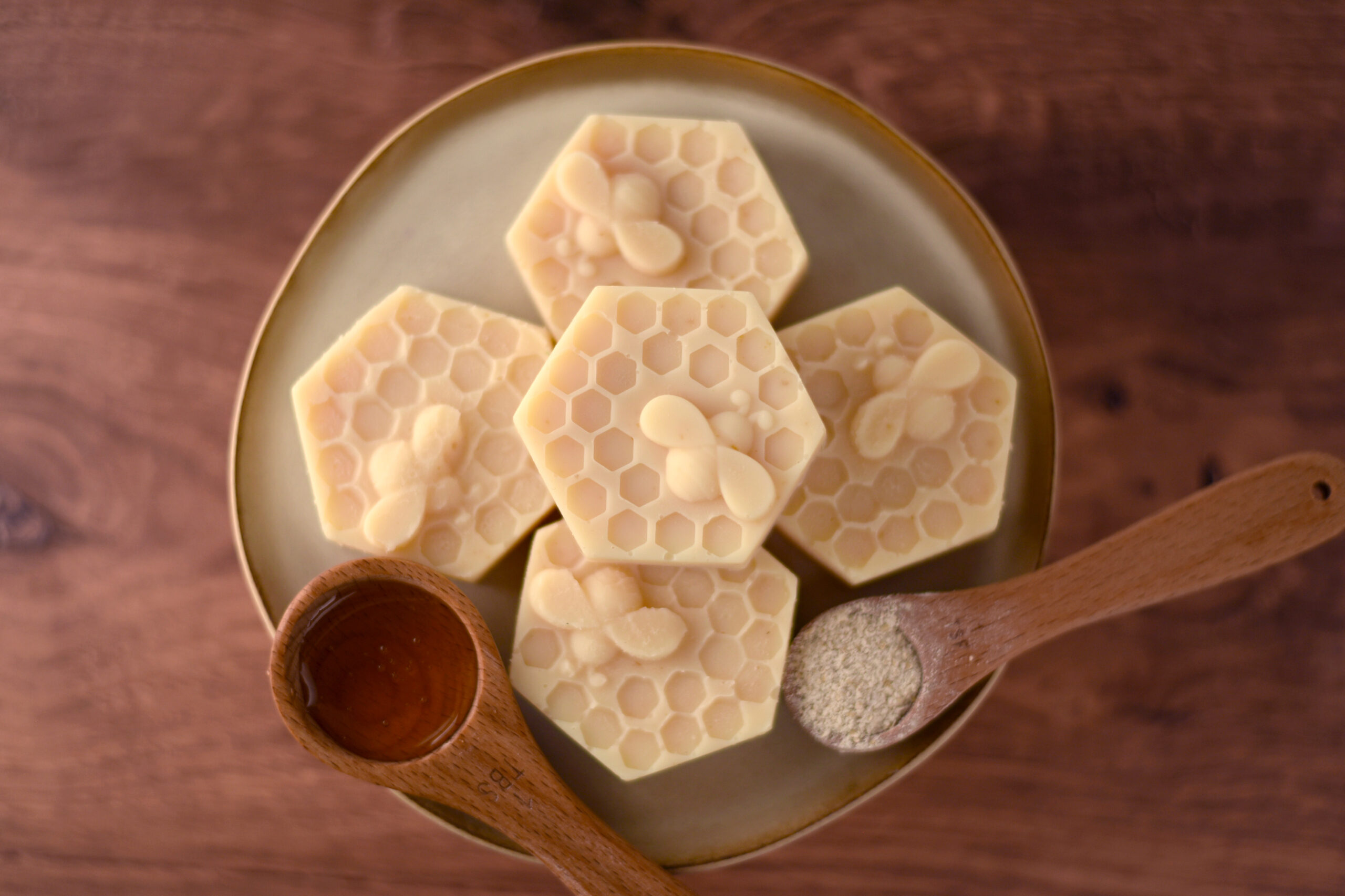
Oatmeal, Milk and Honey is a classic soap to make. It’s one of the first soaps that I made when I first started to make soap. This method of milk soapmaking is a bit different than the other method where we used frozen milk in the lye solution. This method uses equal amounts of lye and water for the solution and then another equal amount of milk is added to the oils. Some people find this method easier when soaping with milk. You can use this method for any type of milk including goat, cow, hemp, coconut, soy, oat…etc.

Oatmeal milk and honey soap

In standard milk soapmaking you typically freeze your milk into ice cubes and use them for your lye solution. This helps keep the temps of the lye solution down and the milk from burning. It can still cause issues such as burning and burnt fat (from the milk) leaving specs in your soap. Not always…but it can happen.

oatmeal milk and honey

In the “Milk in Oil” method…you make a lye solution with equal parts lye and water. Then you add another equal part milk to the oils before you add the lye solution. This prevents milk fat from burning in the lye solution. You also don’t have to go through the hassle of freezing your milk. For some people it is just easier to do.

I like to run my oatmeal through a mini food chopper or a coffee grinder to grind it down some.  The larger the pieces…the scratchier the soap.  I prefer instant as it is softer in the soap but you can use any kind.  I get fresh goat’s milk from another local soaper, Donna.  Learn about her goat’s here.

Let’s make soap!

The recipe:
Coconut oil – 20 oz
Olive oil – 20 oz
Rice bran oil – 5 oz
Avocado oil – 5 oz
Castor oil – 4 oz
Shea butter – 5 oz
Sweet almond oil – 5 oz
Fresh goat’s milk – 9 oz
Oatmeal – 4 tablespoons
Honey – 4 tablespoons

Sodium hydroxide – 9 oz
Water – 9.5 oz

Gear up in your goggles and gloves!  If you are new to soapmaking…visit our beginner tutorial first.

The first step is to make our lye solution.  I mention above to make the lye solution with equal parts of lye and water.  I always add a splash more because sometimes the mixture can fall out of solution if there is not enough water.  Usually equal parts is the most concentrated you should go.

Measure out the water and the lye.  Add the lye to the water and mix in a well ventilated area.

lye solutionPut that to the side.  Weigh out the shea and coconut oil and melt.

shea and coconut oilOnce melted, add all of the liquid oils to the melted oils.

melted oilsAdd 9 oz of milk to the oil mixture.

IMG_2271Next add the oatmeal.  I like to use 1 tablespoon per pound of oils.  We have 4 pounds so I added 4 tablespoons.  You can add more or less depending on your preference.

oatmealI use the same amount for honey; 1 tablespoon per pound of oils.  I added 4 tablespoons.

IMG_2277You can go ahead and your fragrance oil to the oil mixture as well.  My favorite oatmeal, milk and honey fragrance is from Bramble Berry.  I used 3 ounces.

IMG_2278

So now we have the oils, milk, honey, oats and fragrance.  Give this a good stickblend to make sure everything is well mixed.

IMG_2279Take a look at the lye solution.  You might see some floating white filmy stuff.  Give it a mix.  This is just because it is such a concentrated solution and the lye is reacting to the carbon in the air and forming sodium carbonate.  Lye (undissolved crust) stuck to the bottom of your container is bad…white floaties are not.

lye solution Add the lye solution.  Make sure you have your goggles on!

lye solution added to oilsNow it is time to stickblend!  Your mixture might turn bright orange from the lye and milk reacting.

IMG_2284IMG_2286IMG_2287Mix until trace and then pour into your mold.

IMG_2288IMG_2294IMG_2296Okay…so this soap likes to heat up.  Honey and (the sugar in) milk like to heat up when in the mold.  I prefer my soap gelled so I really have to keep an eye on it.  I cover, but I check on it every ten minutes or so.  If you don’t want your soap to gel or are afraid of overheating…you can put your soap somewhere cool like in the fridge or freezer…or even outside if its cold outside.

There is definitely a difference in color between gelled (darker) and ungelled (lighter) soap.

gelled and ungelled soapSo…some things to remember:

You can soap milk two different ways – full milk in lye solution or milk in oils as above.

Additives used:
Oatmeal – rate of 1 tablespoon PPO
Honey – rate of 1 tablespoon PPO

Happy (Goat’s) Milk Soaping!

-Amanda

Beauty in Haiti Workshop – Jan 2013

Marla Bosworth and I just got back from Haiti where we taught the first Beauty in Haiti workshop to the women of OFEDA. We taught workshops on both Saturday and Sunday.

Haiti is beautiful country of extremes. Driving everywhere you can see the rubble and destruction from the 2010 earthquake. Amid the destruction, piles of rocks, tent cities and damaged building are bright splashes and collections of color. Beautiful works of art – paintings, metal art, jewelry – dot the sides of the road. Markets cover the sidewalks with vendors selling fruits, vegetables and other goods. The beauty of the art and colorful fruits and vegetables almost over shine the rubble lining the streets and the collapsed backdrop of buildings.

We had many goals for this trip but basically we wanted to teach the process…one which blends well with their environment (tent camp – no running water or electricity), show them that this is something they can do, source ingredients locally by meeting with Haitian oil/chemical distributors and talk to the women about setting up a business. We were successful with all of our goals for this initial trip. The women are confident in the process and know they can do it. They still have a lot to learn but it was a good start. We met with local business to source supplies including sodium hydroxide, a vetiver distiller and have some leads for bulk oils. When we left we bought some of the soap from the women that we had made to show them that this is something they can make money from.

This trip was a great start but there is still much to do. We do plan on going back. The next trip will involve making more soap, making solid perfumes and firming up the process and procedures that the women will be using and finalizing suppliers in Haiti. We are still raising money through our IndieGogo campaign.

I want to give a big thank you to those that have donated to our project. Thank you to Bramble Berry who donated all of the soap molds, oils, cutters and scales. We told the women that there was a community of soap makers back home that had helped to make these workshops happen and they couldn’t believe it. They just couldn’t believe that people that lived so far away would care enough to make this happen.

Our first workshop was on January 12, the three year anniversary of the devastating earthquake. I don’t even know how to put into words the emotions on this day. Stories were told. That day effected every single person. Every single person lost somebody. The women came to the workshop still excited and happy that we were there. I think it gave them something to take their minds off of what day it was.

Here are some videos and images from the trip. The videos are my favorite. We had told the women to be joyful when making the products and that the joy would be in the finished product. Mostly, we wanted them to have fun. And so they did!

This week in searches…

benefits of using less water in cp soap making

Soap is harder when unmolding – This is great for when you are using silicone molds and individual cavity molds especially when using a high percent of soft oils. Using a water discount makes the soap less sticky, harder and easier to pop out.

Gel phase can more easily be prevented – According to Kevin Dunn, soap with less water is less likely to go through gel phase. Want to learn more? Get his book, Scientific Soapmaking. I know some soapers who prefer un-gelled soap because of how it effects colors or fragrance.

Soap is hard and can be cut earlier – I’m one of those soapers that likes to make a soap and cut the same day. When you are using less water, the soap is initially harder faster and can be cut sooner.

The cure time is shortened – Cure time is all about giving time for evaporation of water and the last bit of saponification to happen. If you initially use less water then there is less to evaporate out during the cure. You still need to allow time for the soap to become milder. I typically cure discounted water soap for three weeks.

On the flip side…the disadvantages are…

Makes your soap trace and move faster. Just keep that in mind if you are wanting to execute a complicated swirl. You can counter-balance this by using a high percentage of liquid oil…especially olive oil which is slow moving.

Can be harder to force gel (If you prefer gel like I do) – I use a heating pad a lot to force gel!

why goat milk does not make enough lather

It’s probably nothing to do with the goat’s milk. Especially since milk contains natural sugars that actually help to boost lather. I would take a look at your recipe. What oils are you using? Use more coconut oil to boost lather and castor oil to help suspend it. But goat’s milk shouldn’t be to blame.

the best mold for cold process soap

This is all a matter of opinion…but at the moment my favorite molds are silicone loaf molds. I like the one from Bramble Berry but many suppliers sell them.

how to pipe cold process soap

Here is a tutorial on cupcakes.

http://www.lovinsoap.com/2012/07/piping-soap-cupcakes-another-palm-free-recipe/

Check out youtube for piping techniques for cupcakes and cakes (not necessarily soap) and you’ll find all sorts of great videos. Also, check locally for a Wilton Cake Decorating class. The techniques you learn for sweet confections can easily be done with soap.

best soap recipe with rice bran oil?

Certainly a matter of opinion…but this is one of my favorite recipes using rice bran.

The recipe:
Almond oil – 5 oz
Avocado oil – 5 oz
Castor oil – 4 oz
Rice bran oil – 5 oz
Olive oil – 18 oz
Shea butter – 5 oz
Coconut oil – 18 oz
Water – 12 oz (I did a discount since I have all of the soft oils)
Lye – 8.4 oz

I love rice bran in soap. It is a good replacement for some of the olive oil and seems to contribute a sheen or shininess to the soap.

my cold process soap is oily

See my troubleshooting page – http://www.lovinsoap.com/troubleshooting/

Oily cold process soap could be caused by a few different reasons.

Overheating – Overheating in the mold can cause oils to separate out and cause an oily film on the top or sides of a soap. Usually if you let it sit…it will reabsorb in a few days.

Fragrance oil – Some fragrance oils can be finicky in cold process soap and do weird things. I have seen a fragrance oil seep out of or almost separate from soap. Usually it is a very thin film and the soap will reabsorb it if you let it sit for a couple of days.

Mis-measurements – If you cut your soap and it is really oily and spongy then you might not have used enough lye. Check your scale, if you need to change the batteries and try to see if you might have mis-measured the lye. Also, lye that is old and clumpy (soaked up moisture from the air) can easily be mis-measured and mess up your recipe. So check your lye.

hot to tell if hot process soap is done

Hot process soap is done when it is translucent and doesn’t zap. The easiest way to check for zap is to dip out a little hot process using a popsickle stick, swish it in the air to cool and harden, touch it to your tongue and see if it zaps. If it doesn’t…it’s done. If it does…keep cooking.

safe clean up after soap making

http://www.lovinsoap.com/2011/08/cleaning-up-after-a-soapy-session/

palm oil versus shea

Palm oil and shea are similar but different in soapmaking. Palm oil is high in palmitic and oleic fatty acids. Shea is high in stearic and oleic fatty acids. The palmitic and stearic properties both contribute to the hardness of a soap. However I don’t consider them one-to-one subs for each other. I like to use a mixture of (additional) olive oil and shea as a sub for palm oil. The two reasons I like to use a mix of shea and olive is that shea butter doesn’t seem to make as bubbly as a soap as palm and it can also be quite expensive to sub that much shea butter into a recipe. Olive oil is soft upon un-molding but cures out really hard so helps with the hardness of a bar.

does felted soap get moldy

No, it doesn’t. Wool dries quickly between uses and is anti-microbial so it doesn’t grow yuckies! Check out this felted tutorial… http://www.lovinsoap.com/2012/10/fuzzy-felted-soap-balls-and-bramble-berrys-spectacular-givember-promotion/

can i use palm oil in my salt bar recipe

Absolutely! But do I? Nope. Salt kills lather so you need to use mostly coconut oil (if lather is important). So if you do use palm oil, use 10-20% palm and 80-90% coconut oil. I personally like a butter or specialty oil in a salt bar instead of palm.

is palm oil and palm kernel oil the same in soap making

Nope. They are two different animals in soap. The only thing they have in common is that they make a hard bar of soap. Palm oil makes a hard long lasting bar of soap. Palm kernel is similar to coconut oil and makes a hard bubbly bar of soap.

Happy Soaping!
Amanda